
The Politics of Progress

Author: Onika Williams
Read Time 5-min | Read post online
You leave the meeting thinking alignment happened.
The strategy was solid, concerns were addressed, heads nodded around the room, and nobody openly pushed back. But then within 48 hours, the energy changes. Responses slow down, a stakeholder suddenly “needs more time,” and a decision – one that sounded settled – somehow feels shaky again.
You can feel resistance forming, even though no one will say it directly. If you’ve led long enough, you know this feeling.
It’s disorienting – especially for leaders who pride themselves on being clear, collaborative, and competent. You did the work. You built the plan. You brought the right people into the room.
So why does progress suddenly feel slippery?
Progress won’t just come from managing the visible structure. It comes from learning to navigate the invisible structure too. And nobody really teaches high-achieving leaders how to do that.
Most organizations operate through two systems at the same time.
There’s the formal structure everyone can see – titles, reporting lines, decision rights, approval processes. Then there’s the real operating system underneath it – trust, history, reputation, emotional influence, unwritten alliances, and the relationships people all quietly protect.
It’s actually the second system that shapes nearly everything.
That second system determines who gets early information, whose opinion carries weight before a meeting starts, who people trust when uncertainty rises, and who can stall momentum without ever publicly opposing anything.
You can spend years being excellent at your job before realizing this is happening around you every day. And honestly, that realization may feel frustrating, especially if you believe good work would naturally speak for itself. I see this tension often with over-functioning leaders – the ones who are respected, reliable, and exhausted all at once.
It’s these over-functioning leaders that keep trying to solve organizational friction by becoming more prepared, more responsive, more accommodating, more available.
Meanwhile, someone else is quietly building influence through relationships and informal trust networks.
That can feel deeply unfair when you’re carrying the emotional load of execution, but pretending informal power doesn’t exist won’t protect you from it. It just means you’re navigating without a map.
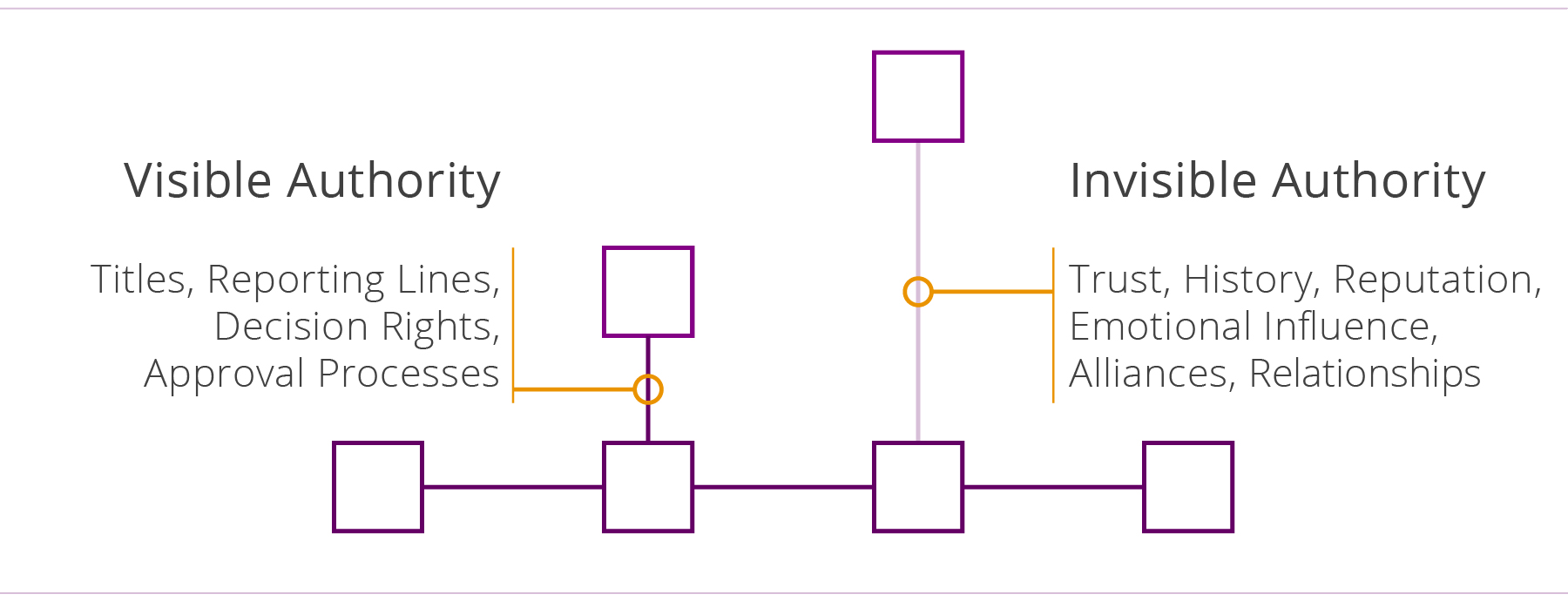
Some of the most influential people have very little authority on paper.
I once worked inside an organization where one senior leader kept struggling to move initiatives forward. On paper, they had everything – executive sponsorship, budget support, a capable team, strong business rationale.
Despite that, projects kept slowing down in subtle ways. It wasn’t anything dramatic, but it was enough friction to drain momentum. People delayed responses, cross-functional leaders became oddly noncommittal, and concerns surfaced late – usually after decisions had supposedly already been made. The meetings themselves started feeling performative, like everyone was discussing one conversation publicly while the real one conversation had already happened somewhere else.
Eventually we realized the leader had spent most of their energy managing upward while overlooking the handful of deeply trusted people who actually shaped organizational sentiment behind the scenes. They were the invisible org chart – the assistant everyone confides in, the person that survived five reorganizations, the person whose skepticism influences the whole division.
If you don’t understand the invisible org chart, leadership starts feeling confusing fast.
Nobody wants to think of themselves as “political.”
It’s often hardest for values-driven leaders – the ones who’ve worked hard to build credibility honestly. The word politics makes people think of manipulation, ego, posturing, or self-preservation, but organizational politics are often much quieter than that.
Sometimes politics looks like protecting relationships, avoiding embarrassment, or trying to maintain a sense of stability when everything feels uncertain. We all do this instinctively. In seasons of change, stress, layoffs, restructures, or strategic ambiguity, these dynamics become even stronger.
You’ll hear “I just have a few concerns about the timing,” but the meaning will be “I’m afraid this change will reduce my influence.” That distinction matters. If you only listen to the surface conversation, you’ll miss the real one entirely.
Read the room before you try to move the room.
At some point, leaders realize influence is not just about having the strongest argument. It’s about understanding the emotional, relational, and political terrain surrounding the argument.
Understanding that requires slowing down long enough to notice who keeps getting consulted informally, whose support creates momentum, and who tends to withdraw instead of openly disagreeing. Underneath that, you’ll find where trust already exists and who feels threatened by the change even if they support it publicly.
None of this is about becoming manipulative. It’s about becoming more aware of the human dynamics shaping the room.
Some of the most burned-out leaders I coach are exhausted because they keep trying to overpower systems that were never designed to move through logic alone.
Organizations are emotional ecosystems – not machines.
The strongest leaders I know are rarely the loudest people in the room.
The strongest leaders are observant. They understand timing, they build trust before urgency forces it, and they pay attention to emotional undercurrents instead of dismissing them. Importantly, they stop personalizing every obstacle.
You’ll find people are simply trying to protect what feels important, stable, familiar, or safe. When you understand that, your leadership changes.
If you don’t understand informal power, you’re managing in the dark.
Reflection Corner
Where might you be over-relying on formal authority while underestimating the informal influence shaping your environment?
If this surfaced something for you, keep going.
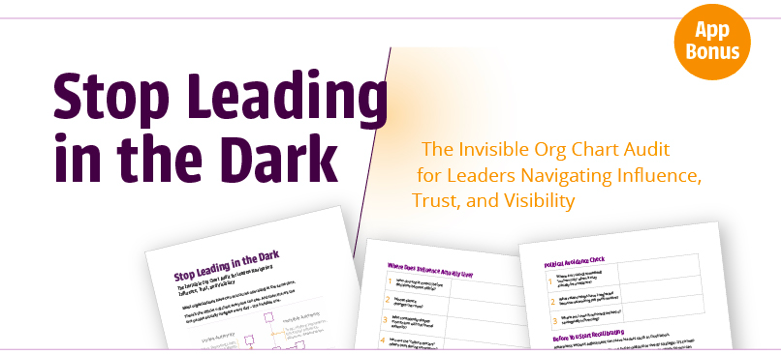
You can’t navigate dynamics you haven’t slowed down enough to see. That’s exactly why I created the Invisible Org Chart Audit. This guided reflection tool will help you better understand the trust, influence, and emotional undercurrents shaping your environment every day. Available now inside the Evolve3 Consulting App. Don’t have it yet – click here to download it today.
P.S. Prefer to listen?
If your inbox feels like too much, Leadership Insights Out Loud gives you another way to stay connected. Get the monthly newsletter and weekly leadership emails read by Onika and delivered through a private audio feed every Tuesday.
Want more insights on influence and informal power? Check out these related posts:



Responses